In recent weeks a number of senior figures in the UK have finally come out and said that Brexit has damaged the UK economy. Keir Starmer, Rachel Reeves, Wes Streeting and most recently Andrew Bailey, Head of the Bank of England, have all acknowledged at different points during October, that Brexit is doing lasting harm to the UK economy. The importance of this development lies in what went before: the relative silence and avoidance that has been practiced by senior labour politicians and public officials since Brexit happened. The Brexit omerta, the ‘elephant in the room’ that we can’t mention, has been a huge frustration to pro-Europeans looking to move closer to Europe. But the taboo is finally being broken. No doubt Starmer, Reeves and Streeting co-ordinated their comments, and no doubt their decision was based on their view that the climate has now changed sufficiently for a more open debate at national level. Let’s hope they are right about that. But what about Bailey? Was he part of the plan? In some ways his was the most telling intervention.
There are risks in this. One of the problems in the 2016 referendum campaign was the widely held view that the ‘establishment’ were in favour of remaining in the EU, and Joe Public should accordingly be wary of pro-remain arguments, particularly those with a ‘project fear’ flavour. Brexit was presented as the democratic option, and the choice for optimists and patriots. We don’t want that perception to creep in again. Starmer et al need to make it clear that they are responding to popular concerns about the effects of Brexit rather than elite ‘I told you so’s. Moving back toward Europe needs to be presented as the path of hope and optimism.
The issue of the European Convention on Human Rights seems to be coming to a head as the Tories and Reform call for the withdrawal of the UK. The European Movement has posted an open letter to Hilary Benn, the relevant minister, calling on him to support the UK’s continued membership. The ECHR issue offers easy prey for the brexiteers in their project to widen the gulf between the UK and the EU. Withdrawal from the ECHR would certainly produce that result, both in generally, and also specifically in relation to the position of Northern Ireland under the EU-UK Trade and Co-operation Agreement, and the Good Friday Agreement. It would be a damaging move, so please sign the open letter.
Its clear that the debate around the ECHR has been inflamed by the involvement of the European Court of Human Rights in asylum appeals. Given the extent of small boats anxiety in the UK, there is a danger of a hostile head of steam building up toward the ECHR among people who are not otherwise anti-Europe; something that has not been widespread hitherto. This could be a problem for the rejoin movement.
What is NOT being widely publicized is the fact that the UK government is pressing for ECHR rules to be amended to reduce the likelihood of the court’s appeals decisions undermining UK government efforts with regard to illegal immigration. According to LBC this proposal to reform the ECHR is already supported by 16 European states (out of 25 signatory states) and has good prospects of success. But it needs to cut through to public awareness. The ECHR performs a very positive role in many areas, and its far better for the UK to push on with reforming it, rather than yet again pull out of an important European institution. As LBC points out, the only country so far to have left the ECHR is Russia. That should give us pause for thought.
Interesting news in the last 6 days on Youth mobility and Erasmus. The BBC has reported that Rachel Reeves has joined EU negotiators in pressing for progress on the UK/EU Youth Mobility Scheme, seemingly pushing back against Starmer’s hesitation on this. She argues that the Scheme would be good for the UK economy. Clearly there’s an urgent need for something to be good for the economy, so maybe here it is. I guess it could go some way to easing labour shortages in certain sectors, such as hospitality. Is that the gift that she sees on offer? If so, she needs to persuade certain of her colleagues, notably Starmer. Good luck!
Meanwhile the IPaper reports that the EU is also pressing for progress on UK re-entry into the Erasmus scheme (student exchange between the UK and the EU). Johnson pulled the UK out in 2020 because its expensive. And it would cost. But the long-term benefits of re-entry to the scheme would far outweigh the costs. Those benefits would be educational, but also social and cultural, and would nicely complement the Youth Mobility Scheme for the younger end of the age-range. Maybe the economic advantages of Youth Mobility would pay for Erasmus. That would be neat.
The headline on the Daily Express website four days ago gives a flavour of the loathing felt by some Brexiteers for the nascent EU-UK Youth Mobility Scheme. But why such antagonism?
The background to this is that the Youth Mobility Scheme, at present being negotiated between the UK and the EU, would allow a specified number of young citizens aged between 18 and 30 from each (UK and EU) to spend time working, studying or travelling in the other. The time-period is under negotiation, and looks likely to be somewhere between 2 and 4 years. Numbers are also under negotiation and a ceiling of 50,000 has been quoted, though the talk is that Starmer still wants to negotiate that down; perhaps not by a great deal, but he needs to be seen to limit immigration whenever he can. And Youth Mobility is vulnerable in that respect. The pressure on him from the Brexit press is unremitting. The main pressure-point around immigration -small boats- presents him still in a role of near- helplessness. So Youth Mobility- one of the most positive possibilities of the recent rapprochement with the EU – is in danger of falling victim to the small boats crisis.
There is too much to lose here. More than ever, we need grass-roots contact between British and EU citizens to combat the growing nationalist mood in the UK; and we particularly need it among the young. Reform is making a successful pitch for support among young men, and there needs to be a counterbalancing experience that tells a positive story about Europe and Europeans. Of course contact with Europeans will not purify all our youth of the taint of nationalism – some of our young visitors will support the AfD and the RN – but the experience of international dialogue will nonetheless open many minds. No wonder the Express doesn’t like it.
So we can’t afford to lose on Youth Mobility. It needs to be decoupled from immigration in the public mind, presented in a different frame, associated with the positive connotations of European cities and friendly visitors. Its all about presentation. The Brexit press know that, and that’s why they are doing their best to kill it.
Branch members leafleted in Belper last Saturday. The response was very positive overall, as most people who stopped were pro-EU and Rejoin. There was also a general feeling that as Farage is responsible for our current mess he has no business claiming he can fix it.
A group of us from the Derby branch did some leafleting on St Peter’s Street last Saturday (August 23rd). The plan was to provide some information to Derby residents about the March for Rejoin in London on October 18th. This produced a mainly positive response from residents, many of whom wished to speak of their negative experiences and disappointments since leaving the EU, and expressed a hope to rejoin.
There were, of course, those who took a negative view and did not wish to engage in conversation. Also, many were preoccupied with asylum seekers, and were not really interested in talking about anything else. That issue has really muddied the waters for discussion of our relationship with Europe, and the pro-Brexit camp are working hard to ensure the waters stay as muddy as possible. Its time the government made more effort to counter that misinformation.
Clearly its vital that we get out onto the street and talk to people face to face. I don’t know if we persuaded anyone on Saturday; but it was a useful reminder of what people ‘out there’ are thinking.
Hot on the heels of his meeting with Macron, Starmer met with the German Chancellor Friedrich Merz last week. Clearly a lot of talking had been done under the radar beforehand, because an agreement- the Treaty of Kensington- emerged very quickly. This covers a range of areas as follows (I quote)
diplomatic cooperation on broader geopolitical issues;
defence and security;
internal security and coordination on combating illegal migration;
Mutual support on defence is the ‘centre of gravity’ this treaty.
Together with the Macron-Starmer agreements a few days ago, it recreates the E3 group: The UK, France and Germany. This trio has the potential to provide the hub of the (slowly) developing European security system.
Its clearly a grand plan, slowly manifesting.
However, part of the context provided by von Ondarza makes depressing reading. The UK has drifted away from Europe on many levels since 2016, and he offered two examples relating to Germany:
The UK dropped from Germany’s third most important trading partner in 2016 to ninth in 2024
school exchanges from Germany to the UK have fallen by more than 80 per cent since Brexit.
However, it looks as though someone is finally trying to reverse that.
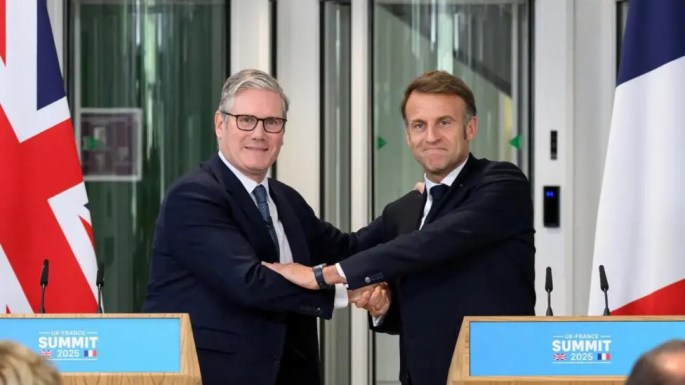
The recent visit by President Macron has resulted in several agreements between France and the UK, the usefulness of which will only become clear in the longer term. One of these is the ‘one in one out’ agreement concerning the exchange of illegal migrants between the UK and France. At first sight the scale of this deal seems very modest indeed, and the fact that it seeks to address a problem that looms so large in the UK only serves to emphasize its very limited scale. But presumably it could be expanded if it works.
And if it does work, it will perhaps vindicate Macron’s comment about Brexit, made during his visit. He said (I paraphrase) that Brexit was sold to the British public on a false claim; the claim that Brexit would give the UK more control of its own borders and, by implication, enable it to keep more people out of the country. But, Macron argued, the truth is that Brexit has in fact made the UK less able to control its borders, because border control depends on co-operation with neighbouring states (obvious when you think about it), and that co-operation was disrupted by Brexit. And that explains the increase in illegal entries since 2020. Probably Macron is right. But why did he say it? His remark seems to have been addressed to the British public, and Macron must know that he would annoy a lot of people and provoke a backlash from certain quarters. Lecturing us on our bad decisions doesn’t seem a good way to win friends and influence people this side of the channel.
One possible explanation for Macron’s remarks is that he is weak at home (having lost control of the national assembly), and he feels he needs to compensate by high-profile initiatives in foreign policy. He has two years of his second term to go, so he may also be thinking in terms of his legacy. And anyway there has always been a tension in the relationship between France and the UK, with partnership and rivalry closely intertwined. Something that annoys the British might amuse the French. So perhaps his remarks were ultimately aimed at his own people. Overall the French are less preoccupied with illegal migrants than the British, but local opinion along the French north coast is nonetheless somewhat inflamed on the issue. The mayor of Calais was not impressed by the Macron-Starmer deal. There is a danger that it is already suffering an image problem
In the longer run, the practical effectiveness of the agreement is of enormous political importance. If a narrative can be established that closer co-operation with our neighbours does in fact improve our control of our borders, this will further discredit Brexit. For this reason, I guess, rejoiners should want it to work, and to be seen to work. And for the same reason, brexiters presumably want it to fail, and to be seen to fail. Brexiters need to establish a counter-narrative that co-operation with Europe solves nothing and compromises our sovereignty, and that European leaders are strutting popinjays who cannot be trusted and wish us ill. Farage and Philp have already started work on this. For them, this agreement needs to be discredited. Macron’s lecturing is irritating, but it will be forgotten- or possibly vindicated. What brexiters really need is for the agreement to go badly wrong, or to seem to go badly wrong. Pro-Brexit media will buzz round it like flies on a cowpat over coming months, looking for anything that feeds their agenda. Starmer needs to talk up the agreement for all he’s worth, but tread carefully in implementing it.

 derby4europe