Grassroots for Europe Programme 2025


Below is a summary of grassroots for Europe events in coming weeks

12 2 25 AGM

12th February 20025 at 7:30pm. This will replace the Open Forum which is

normally scheduled on a Wednesday at that time.

All GfE Council positions are up for renewal, and some current council

members are standing down. Can you all please consider nominating yourself

or someone else in your local group? There are twelve positions including

chair and vice-chair, and we require at least one person from each region:

Northern Ireland, Wales, Scotland, England outside London, London, Europe

outside the UK. More information will be posted in January 2025, but please

let us know as soon as possible if you are intending to stand, so we can co-

ordinate accordingly.

In the event there are insufficient nominations to Council to require an

election, we will confirm during the AGM who the council members are.


7 1 25 Grassroots for Europe Round Table Webinar

#RT52: “Eradicating VAWG; Empowering

Europe”

Join Grassroots for Europe and Young European Movement UK for a

special joint Round Table webinar #52 online on January 7th – an expert panel

discussion on Eradicating VAWG, Empowering Europe.

This webinar will review and mobilise support for action at national and

European levels to halt the current pandemic of violence against women and

girls (VAWG) across our societies. One woman is killed every three days in the

UK, and two a day across the EU. YEM UK has identified VAGW as a priority

issue in 2025 and is conducting its own campaign, Break the Silence to End

the Violence : https://1.yem.org.uk/break-the-silence-to-end-the-

violence/. Please see fuller details of this forthcoming launch event further

down this mailing.

The European Parliament has just been debating a programme of emergency

action to tackle this Europe-wide issue. Following on from this European

Parliament debate on December 11th, panellists will discuss how to halt this

trend and review progress on the implementation of the EU Directive on

VAGW, plus Labour’s performance against their pledge to halve VAWG,

followed by Q&A and discussion.

🎤 Chair: Cecilia Jastrzembska, Senior Policy Advisor, YEM President & Co-

Director, European Movement Board & National Council, Control Commission,

Young European Socialists, 50:50 Parliament Ambassador and freelance

political journalist.

http://www.LinkedIn.com/in/ceciliaeve

Panelists:

🎤 Dorothy Herson: YEM UK Vice President, editor at Cambridge University

Press, author and lawyer

🎤 Hannah Phillips: Intersectional gender equality policy expert, Civility

Commission Manager, Jo Cox Foundation; Gender Parity Consultant, United

Nations

🎤 Sara Harris: Ask For Angela Project Worker for Leeds. Access &

Assessment Team Support Worker. Support Worker at Women’s Night Safe

Space.

Discover YEM’s campaign, art exhibition, poll and more on ending gender-

based violence here: https://1.yem.org.uk/break-the-silence-to-end-

the-violence/

Find Grassroots For Europe’s website for more information on previous

speakers and activities here: https://grassrootsforeurope.org/the-

round-table/

This free online event is open via registration to all who share our concerns.

All donations go to YEM – a small optional donation helps YEM to resource its

ambitious growth agenda.

Zoom link will be notified to attendees ahead of the webinar


16 1 25 What does a Trump Presidency mean for

Europe?

Join the European Movement in Scotland for a timely and

thought-provoking webinar just days before the

inauguration of the 46th President of the United States. This special event will

bring together a distinguished panel of diplomats, academics, and activists to

discuss the key challenges and opportunities Europe may encounter over the

next four years as it navigates a rapidly changing global political landscape.

Chaired by EMiS Vice President Alyn Smith, this event will feature a keynote

discussion with Lord Kerr of Kinlochard, the former British Ambassador to

both the United States and the European Union. Lord Kerr brings unparalleled

insight into transatlantic relations and the complexities of European

diplomacy.

With topics ranging from the future of EU-US relations to pressing global

issues like climate change, trade, and international security, this event will

provide a platform for meaningful dialogue and fresh perspectives. Additional

speakers will be announced soon, promising a rich and diverse exploration of

what lies ahead for Europe.

Date: 16/01/2025

Time: 19:00 – 21:00 GMT

Cost: Free

Register: https://www.eventbrite.co.uk/e/what-does-a-trump-

presidency-mean-for-europe-tickets-1113603109879?

aff=ebdsshsms&utm_share_source=listing_androidJ


23 1 25 Break The Silence / End The Violence

Join YEM for our much anticipated campaign to raise awareness of,

destigmatise discussion of and combat gender based violence (GBV) and

champion gender equality. With GBV declared a national emergency in the UK

and levels rising in several EU member states, this discussion comes at a

pivotal time. An expert panel will examine the implementation of the Istanbul

Convention across the EU and performance against Labour’s pledge to tackle

violence against women and girls (VAWG) in the UK.

Followed by discussion and Q&A as well as a networking reception.

Attendees will also have the opportunity to explore materials from the official

Silence exhibition, a joint venture with multi-award winning artist

Break The Ally Zlatar.

Chair: Emma Nelson, Presenter, journalist, podcaster and broadcaster.

Currently reporting for Monocle 24 and former BBC reporter.

Speakers:

🎤 Frances Fitzgerald: former MEP and Vice President of the EPP Group, Co-

Rapporteur of the EU Directive Criminalising VAWG ratified earlier this year,

and member of the Gender Equality Advisory Board. Prior to her election to

the Dáil, Frances served as Chair of the National Women’s Council of Ireland

(1988-92) and Vice President of the European Women’s Lobby, as well as

serving as Tánaiste (2016-17).

🎤 Cecilia Jastrzembska: YEM President & Co-Director. Senior Policy Advisor

with six years experience in central UK government,

🎤 Sanna Lepola: gender equality expert and Director-General for

Parliamentary Democracy Partnerships, European Parliament, which fosters

cooperation and legislative dialogue with national parliaments by providing

advice and expertise to political bodies, members and administrative entities.

This is an in-person event in London.

Date: 23/01/2025

Time: 18:30 – 20:00 GMT

Venue: Europe House, 32 Smith Square, SW1P 3EU London

Website: https://docs.google.com/document/d/18pLszzh-

RjA_2wy0ZagQ6e8RfduvmN4q7QHNuCxlrOk/edit


23 1 25 The Independent

Most of Britain might have expected Brexit to be a thing of the past by now,

buried in our pre-Covid subconscious. But, as we approach the eighth

anniversary of the referendum, Brexit-related issues are just as prominent

and divisive as ever. Critics of Brexit are more vocal than ever and concerns

abound about food imports, tightened rules for EU holidaymakers and

security.

Join The Independent’s Chief Political Commentator John Rentoul as he

discusses all things Brexit past, present and future with a panel of experts.

Date: 23/01/2025

Time: 19:00 – 20:00 GMT

Register via EventBrite here: https://www.eventbrite.co.uk/e/will-the-brexit-headache-ever-end-tickets-893706870

 

Happy New Year

2024 has been an important year for pro-Europeans, giving us, as it has, a Labour government in the UK and Trump in the US.  July 2024 marked the end of five years of a ferociously Brexiteer Tory government, purged to resemble a revolutionary vanguard, and determined to reshape the politics and culture of the UK. Rejoiners were just one group among many whom the Tory Brexiteers identified as enemies, as we shared that honour with the BBC, the legal profession, teachers, universities, the Woke of every description, and of course the EU itself; among many others. Over those five years the atmosphere in the UK was highly polarized and, despite seeking to be a broad church, pro-Europeans were placed in a position of direct antagonism to the government.

Now, six months after the election, the situation is transformed, and everything is much more complicated. With Labour in power, we move from polarization to ambiguity. We know that most Labour MPs, members and voters are anti-Brexit. But holding an opinion and deciding a course of action from that opinion are very different things. Though we hear and read pro-EU opinions from Labour quarters often enough, action moves very slowly. There is clearly an active dialogue between the UK government and the EU commission on a number of fronts. Those involved in campaigning for rejoining Erasmus, the EU student exchange programme, will feel some encouragement from discussions over youth mobility, though agreement still seems a good way off. Progress on other key areas, security, fishing and the veterinary agreement, is also slow and halting.

Meanwhile, having lost the government, the Brexiteer centre of gravity has migrated, and now bestrides the Atlantic.  Trump has been hostile to the EU since his first administration, and many commentators anticipate that he will use the stick of tariffs and the carrot of a trade deal to coerce the UK away from the EU and toward economic subjection to the US. In that event we would be required to sacrifice much of what we value. The biggest sacrifice, probably, would be our health. We would be required to abandon many of our food standards to allow US imports; and we would be expected to open our National Health Service to predatory US healthcare provider companies. Moreover Trump’s ally Elon Musk is threatening to use his colossal wealth and influence to undermine the present UK government. And they have a serviceable outrider in Farage. He evidently sees himself as Trump’s representative on earth, and given his political skills, its likely that he will perform that function very effectively. So, having endured five years of a home-grown Brexit hegemony, we will now be facing four years of the transatlantic version. Does Starmer have the guts to stand up to this? De we?

As to the European Movement itself, I quote Chair Mike Galsworthy’s end-of-year message to members emailed on December 27th. His list of achievements is as follows:

  • “Our movement now holds the secretariat for the All-Party Parliamentary Group (APPG) on Europe – a move welcomed by the government and which has huge potential to drive political change from the heart of Westminster. 
  • Our movement welcomed Caroline Lucas and Dominic Grieve KC as our new Co-Presidents, backed up by a stellar new line-up of Vice-Presidents and patrons
  • Our movement ran our first Europe Day in collaboration with the National Liberal Club, bringing Guy Verhofstadt from Brussels to join us.
  • Our movement launched a Manifesto on Europe during the general election and sent it to thousands of political candidates, making their replies available via our online tool.
  • Our movement has launched nationwide campaigns, with Face The Music, This is Erasmus, and a call for an inquiry into the future UK-EU relationship.
  • Our movement is now getting into national press more frequently than ever before and we’re building media capacity fast.
  • Our movement now has 24,000 members – and is growing every day

In addition to all that he is asking for ideas from members on what the EM should be focusing on in 2025. Reply to info@europeanmovement.co.uk

Other pro-rejoin organizations have also been active during the year. These include broadly focused groups such as Grassroots for Europe, the Rejoin Party and the March for Rejoin, as well as specifically focused organizations such as Thank EU for the music, and the Festival of Europe (see our ‘Get Involved’ page for links to these). The March for Rejoin successfully organized the second annual march, in London, in September.

New Year is a good time for reflection and reappraisal, and Mike Galsworthy’s request for ideas is worthy of a response. So, when it comes to thinking outside the box, there’s no time like the present.

Happy New Year

Stephen Wilmot

Recent Campaigns

The European Movement has recently instituted three campaigns asking the government to do the following:

  • Take the UK back into Erasmus, the EU student exchange scheme.
  • Negotiate better access for UK Musicians to tour in Europe.
  • Initiate a public enquiry into options for developing the UK-EU relationship.

These involve either writing to your MP or signing a petition.

Links to the relevant websites are below. Also please see the News, Campaigns & Events page for more information.

https://www.europeanmovement.co.uk/this_is_erasmus

https://www.europeanmovement.co.uk/face-the-music

https://www.europeanmovement.co.uk/contact-mp-inquiry-uk-eu-relations

Trump

This is a statement from the European Movement at national level, issued following the result yesterday of the US Presidential Election.

“Donald Trump’s US election win brings with it the prospect of a trade war, which could have a traumatic and destabilising effect on global trade – potentially putting Rachel Reeves’s recent growth plan for the UK economy in jeopardy. Stronger UK-EU defence ties are also now more crucial than ever – with the days of outsourcing protection to the United States now over.

Respected think-tank NIESR (National Institute of Economic and Social Research) said today that Trump’s policies could halve the UK’s already low growth and push up inflation. It now makes no make sense to stay economically isolated from our European neighbours: we need a red alert, not just a reset and more red lines. 

Sir Nick Harvey, CEO of European Movement UK, said:

“The future of Europe depends not on elections on another continent but on Europe fulfilling its own destiny and own place in the geopolitical landscape.

“The UK needs to make a clear choice to be part of that European strength, in the interests of all of us – on defence and security, just as much as on trade and the economy.

“The time for posturing on the sidelines is over. Sensible conversations are more crucial than ever before, about the damage of leaving the European Union, and what shape our future relationship should take.”

Dr Mike Galsworthy, Chair of European Movement UK and founder of Scientists4EU, said:

“If you even needed another reason for the UK to join the EU – here it is.

Europe can no longer rely on protection from the US. It has to stand on its own two feet and look after its own defence needs and obligations, and the urgent need is for Keir Starmer’s government to be absolutely front and centre of that revolution in Europe’s defence capabilities.

“Brexit was always going to fail on its own terms, but a Trump win makes the UK even more stranded in an increasingly toxic place.

“For the UK, for Ukraine, for European security, and for building a bastion of decency in the world, we must urgently forge much closer ties with the EU.”

European Movement UK 

Mandelson says Rejoin could start in 10 years

Peter Mandelson recently said he thought talks on UK re-entry to the EU could start in 10 years. He identified some of the things that would need to happen to make this possible, including a significant improvement in the UK economy, and a restoration of trust between the UK and the EU. The second of these would require better conduct of diplomacy on the UK side. This estimate (as he pointed out) is somewhat in advance of Starmer’s recent statement that rejoin will not happen in his lifetime (he is 62). But then, Mandelson can say what he really thinks.

I want to take Mandelson as my starting point and consider the 10-year frame for rejoin. Clearly he is right about the UK economy. Investment and productivity need to improve significantly for the UK to be seen as a potential asset to the EU. Starmer’s government sees economic progress as a two-term job, and that means ten years. And there’s no guarantee that it will be achieved.  Much depends on outside factors. But the recent Draghi report on the Eurozone economy must likewise have impacted the confidence of the EU’s leadership, presenting as it does a comparable economic challenge for the EU. There are similarities between the problems of the EU and the UK, particularly with regard to lack of investment in potential growth areas. An EU that feels economically vulnerable will likely be pessimistic about the prospects of readmitting a similarly vulnerable UK economy.

On the other hand, the UK is a military power- particularly a naval power- on Europe’s doorstep, and in an increasingly insecure world, the EU might see it as desirable to have the UK back in the fold, despite economic weakness, because of that naval power.  More of that below.

We already know that either way, more ground needs to be made up in the EU/UK relationship because of the pattern of hostility and  bad faith that UK conservative governments have pursued against the EU since 2016. That pattern needs to be broken by Starmer and Lammy in an unambiguous way, and a relationship of trust and mutual esteem needs to be established. Work on this has started, but the UK’s attitude – Starmer’s attitude, specifically – is ambiguous and inconsistent. Progress on Youth Mobility would be a building-block of trust, and that could be progressed substantially in five years, let alone ten.

However, internal politics holds these processes to ransom on both sides of the channel. I shall focus on the right wing of politics in both cases, as the political centre and left are generally well-disposed to UK rejoin, so much depends on the direction of travel on the right wing, both in the UK and in the EU. In the EU the far right is prospering, and is likely to become more influential in coming months and years. They are characterized by varying degrees of Euroscepticism, some of which (eg  Meloni) seem to be contingent and accommodatable, others of which (eg AfD) look more dangerous. What happens to these movements over the next ten years is crucial to the EUs prospects, and to the UK’s prospects of reconnecting. The European far right could break up the EU, or they could make it their own.  

The right wing in the UK is, at present, almost entirely pro- Brexit and anti-EU, at least in public. The Conservative Party is both those things, and Reform even more so. Could this change over the next decade? At present the prospects look poor.  Reform, which appears to have considerable growth potential, exists primarily as an ethnic nationalist, anti-foreigner party.  Their agenda is to cast the EU as an enemy, alongside immigrants. The Conservative parliamentary party has been purged of overt remainers, and at present no Tory MP dares to express any positive views about Europe (Peers are a slightly different matter). Tory membership in the country has always been Eurosceptic. 

So what might change on the UK right? The only real hope must lie in the passage of time. The present generation of leaders will be on their way out in ten years, and we don’t know who will succeed them. We don’t know which way thinking will go in the younger reaches of the Conservative party. Witch-hunts tend to run out of steam after a few years, and people become weary of the resulting polarization. Also we don’t know what kind of nationalism will dominate the right wing of the party ten years from now. If its civic nationalism, that would at least allow right-wing Tories to be a little friendlier to neighbouring countries with similar institutions to ours. If its ethnic nationalism, no foreigner is to be trusted. As for the conservative party membership, the grim reaper will dispose of many of those, given their age profile. But there is no guarantee that they won’t simply be replaced by slightly younger members of a similar ilk.

The other great imponderable is the direction of travel in the rest of the world. US politics took a change of direction in 2016 and shows no sign of reverting to what we would once have called ‘normality’. If Trump wins, his administration will have little interest in the UK, considerable hostility to the EU, and deep ambivalence toward NATO. If he is succeeded by Vance, that is likely to continue for most of the ten-year period.  If Trump pulls the US out of NATO, the UK will be in sore need of allies nearby, and will in any case need to give priority to the security of Europe. As one of the more significant military powers in Europe its relative importance would inevitably grow, drawing it into a closer involvement with its EU neighbours; unless it consciously chooses an isolationist future.

 If Harris wins, the US position will be more like the present one, which involves an ongoing pivot away from Europe and toward the Pacific. So the drift of America away from Europe and NATO will be slower. A Harris administration is also more likely to want to recreate the pre-brexit situation where the UK acted as a bridge between the US and the EU. The logical implication of that is that she would be predisposed to encourage closer links between the UK and Europe. Its not clear what priority that would have for her, but it would be a nudge in the right direction.

What about the rest of the world? Russia is unlikely to get any friendlier after Putin. Probably it will continue to threaten Europe, and try to undermine the EU by adopting disruptive proxies such as Orban. China is being wooed by Starmer and Reeves now, as a source of investment into the UK, and that may progress into a better relationship. But it is not clear whether the Chinese see any advantage for themselves in either keeping the UK out of the EU, or pushing it toward rejoining. Either way the EU is a more important trading partner for China than is the UK, and a workable relationship with the EU is probably a higher priority for them. If China decides to take a clear stance regarding the UK rejoining the EU, their overal weight and influence in the world may make that a significant factor in the process.  

I have assumed so far that the EU will remain in a ‘steady state’ over the next ten years, so that we can plan and predict around it. Almost certainly that assumption is wrong. I have mentioned the need for action to improve economic performance, and that is imperative if the EU is to remain stable. But forces other than the financial are at work also in the EU – social, cultural and political – and these may produce important changes in the next ten years. These may offer opportunities for the UK in its relations with the EU, but it will be just as likely to present challenges. That’s a bigger subject, for another time.

So all in all Peter Mandelson looks rather optimistic in his ten-year projection. But his experience of politics and diplomacy, particularly around the UK and the EU, is unrivalled, and he has proved an astute observer and operator over many years. He has much experience of how things can change, and of what changes can realistically be achieved. Last but not least, he will certainly be fully aware of all the potential problems that I have outlined here. But he is still optimistic. Well, optimists often achieve more than pessimists. We should take him seriously.

Stephen Wilmot

March for Rejoin 28 9 24

(Picture Courtesy of The Canary)

I maybe chose the wrong way of getting to London last Saturday. The East Coast route to St Pancras seemed to be out of action and instead I had a ponderous two and a half hour run via Tamworth to Euston. But from Euston to the start on Park lane was a brisk 30-minute walk; much easier and pleasanter. We were told the March moved off at 1.00pm but as I approached Park Lane there seemed nobody else around who looked like a marcher. I started to panic. I was relieved to come to a crowd of bereted and flag-waving marchers further down Park Lane, and soon there were lots of us- a sea of blue and yellow. We were a bit late starting- more like 1.30 – and the first 30 minutes was slow and halting as we inched along the pavement. But from Hyde Park Corner it looked as if the road was closed to traffic and we were able to spread out and move forward faster.

The Rejoin Party was represented at various points, and I later saw Brendan Donnelly in Parliament Square.  Grassroots for Europe were also well in evidence. There was clearly a well-organized operation to ensure everyone was supplied with posters, flags and badges. Friendly people doled out these items at various points, and there seemed to be an abundance of stuff. As I understand it the March for Rejoin is an autonomous organization, so I guess their people were doing this.

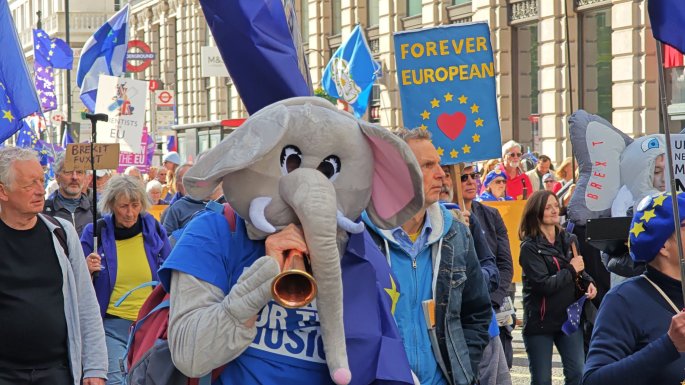
We spread along Piccadilly and Pall Mall, and as we walked along Whitehall we were applauded by several onlookers. Lots of tourists also, who looked a little bemused. No hostility at all.  I fell in with a group of elephants – or leastways people with elephant masks on. They were representing the ‘Thank EU for the Music’ campaign for better access to and from the EU for musicians. In an under-reported march, they actually got a spot in Monday’s i, so they did us all a bit of good. The ‘Elephants in the Room’ theme clearly has legs.

By the time we got to Parliament Square I had drifted forward, and when I looked behind me I realized for the first time what a multitude we were. People kept streaming in from Whitehall and our MC had to pester us all from the platform to move to the front. We milled around for a while, enjoying a hilarious rap version of Donald Trump’s ‘They’re eating people’s pets in Springfield’ speech, set to music on the big screen. Then my time ran out. Back to Euston.

Young European Movement

Below are extracts from a recent email received from the Young European movement. This gives you an idea of what they are about. If you want to support them you can

find them on https://1.yem.org.uk/

“YEM is an inclusive, cross-party campaigning organisation, with team members hailing from all the major parties, including; The Labour party, Liberal Democrats, Conservatives and Greens. Nevertheless, the change in government is an opportunity for young campaigners to seek some meaningful change on issues like youth mobility and Freedom of Movement, which were not previously possible.

Talk of introducing a new youth mobility scheme is an exciting opportunity for young Europeans, although it falls woefully short of where we want to be; a society where all Europeans can live, learn and work where they choose. We are excited that this topic is finally on the table. 

We urge the new government to take a bold step and listen to the 52,000 people who signed our petition calling for a return to Erasmus+. 

This is not a campaign that will go away, and we would love your support in helping us keep the pressure up.

Your support is always appreciated, whether you identify as youth or not, because youth mobility doesn’t just support the next generation, it enriches all aspects of our society, through culture, research and the economy. “

“What we’ve been doing

YEM at the SNP Conference

We’ve already kicked off the party conference season up in Scotland, signing up young members of the SNP to YEM and encouraging them to speak out for their pro-EU future. Scotland overall didn’t vote for Brexit, let alone Scotland’s youth. YEM will be present at all of the party conferences, so keep an eye out for us and say hello!

Petition to the new PM

In August our new President, Cecilia Jastrzembska, handed a petition with over 30,000 signatures to the new Prime Minister, urging immediate action to rebuild the UK’s relationship with the EU. Recent polls show 59% of Britons now support rejoining the EU, marking a clear shift in public opinion.

Our upcoming campaigns

We’re excited that after a summer of preparation we will be hitting the ground running. We have been preparing for University Freshers Fayres, reconnecting with affiliated societies, setting up societies and getting ready to send delegates to all the Party Conferences (well except from the Brexit Reform Party of course!)

We will need your support if we want to pull off a year packed with pro-EU youth engagement. We have a fantastic group of people who back us with a regular monthly donation – but we need more people to join to help us fund this. As we have discovered, the fees alone to attend Freshers Fayres at Universities are astronomical. 

If you want to help us, become a Friend of the Young European Movement today

“Launching our next campaign!

We’re launching our new campaign, “Break the Silence to End the Violence,” to tackle gender-based violence (GBV) and promote gender equality across Europe. Despite progress, gender inequality remains a major issue, and GBV is still a serious threat, especially in the UK, where femicide rates show no significant decline.

The European Union has recently taken important steps to combat GBV, but Brexit has created challenges for the UK in aligning with these efforts. With GBV costing the EU €366bn and the UK £40bn annually, it’s clear that addressing this issue is both a moral and economic necessity.

Rebuilding ties with Europe and aligning our policies on gender equality could help the UK better combat GBV. Now is the time to unite, push for change, and ensure that gender equality becomes a reality across Europe.

How can you help?

The Young European Movement needs your help. Our impact on the new UK government will be limited if we are trapped in an echo chamber reaching only those who already support us. We need to engage millions more, especially the next generation of Britain’s pro-EU youth.

That means going out to universities, growing bigger on social media and targeting young professionals. This costs a lot of money, we rely on donations from people like you regardless of their age. We need your support.

The best way you can support us is by becoming a Friend of the Young European Movement and giving £5 a month, your donations go straight into building our campaigns and getting our voices out there. “

National Rejoin March

Below is a summary of the latest notification received from the European Movement about the forthcoming Rejoin March.

The third National Rejoin March is just a few weeks away, taking place in London on Saturday 28th September

Bringing together pro-European groups from across the political spectrum, including European Movement UK as an official partner, the event is one of the largest public pro-European events of the year. 

This is an opportunity for us to tell the new government, loud and clear, that Brexit was a mistake and it’s time to put Europe back on top of the political agenda. 

Tensions are thawing. Now is the time to push forward and once again get closer to our European neighbours, step by step. 

Our chair, Dr Mike Galsworthy, will be attending alongside members, supporters and local groups from European Movement UK. 

Details, such as the timings and the main and accessible routes, will be posted by the event organisers, National Rejoin March

See you there, 

European Movement UK 

More bad news for Brexit

Aston University’s Centre for Business Prosperity have analysed the monthly trading figures between the UK and the EU since 2021.  Their finding is that the Trade and Cooperation Agreement, negotiated by the Johnson government, has had a negative effect on UK-EU trade. They use the term ‘stifling’.

It shows a 27% drop in UK exports to, and a 32% reduction in imports from, the EU.  It also shows a 33% decrease in the variety of products exported from the UK.

The implications of this for the UK’s economy are clear; and bad. Its one of the most damning pieces of data on the effects of Brexit so far. I guess it won’t be the last.

More information, plus a PDF of the report itself, is on the Aston University website:

https://www.aston.ac.uk/research/bss/research-centres/business-prosperity/unbound

Starmer’s Strategy

Rejoiners can only feel hopeful about Keir Starmer’s quest for a closer relationship with Germany. Still the economic powerhouse of the EU despite its present travails, Germany’s goodwill toward the UK will be crucial in creating a closer economic relationship with the EU as a whole. All this is moving in the right direction.  

So why was he (or rather his news-management machine) making such a song and dance about not agreeing to Youth Free Movement and not rejoining Erasmus? That looks like mixed messages.

Steve Anglesey in ’The Rejoinder’ (Aug 29) suggests a three-part explanation for this behaviour. First, Youth Free Movement and Erasmus look too much like the dreaded  freedom of movement, and we know that immigration is at the top of the British public’s list of anxieties at the moment.

Second, he doesn’t trust the apparent shift in public opinion about Brexit. Anglesey doesn’t say this explicitly, but I guess we might suppose that Starmer suspects the opinion shift against Brexit is shallow and unreliable; not a firm basis for political action. And he may well be right.  In the light of both of those considerations he chooses to hold off risking a ‘betrayal’ backlash, waiting (Anglesey suspects) until the Tories have a new leader, and are fully engaged in warfare with Reform about what counts as a good Brexit.  And therefore have less spare firepower to turn on him.

Those calculations may be sound.  However, that is not a reason for rejoiners to go quiet and wait on events. Those events may keep Starmer spooked indefinitely, and we need to create a counter-pressure against his natural caution. This pressure would need to be long-term, as the process of reconnecting with Europe is probably going to be a slow one. And it would need to be focused, with clear priorities.

There is a rationale for keeping our focus on Youth Free Movement in general, and Erasmus in particular. They should have priority in any campaigning for rejoin, for the following reason:

One of the strongest cards in the brexiteers hand throughout their long campaign, was the fact that British people identify less with Europe, on average, than do most other Europeans. Several surveys have shown over the years that European-ness constituted a fairly small part of the average Britons sense of identity. This meant that commitment to EU membership always tended to be shallower, more conditional than is the case for other Europeans.  This gave leverage to the brexiteers, and we have all suffered the consequences. In the long run this could get worse, with a vicious circle of ongoing Brexit isolation producing an even more insular nation. That would be bad for all of us.

In moving the country back toward Europe, we need to invest in a long-term cultural shift toward a stronger European identity, making Britain a stronger and more stable part of the European family. And we need to focus on is the younger generation. The more positive contact they have with other Europeans, the more European they are likely to become in their outlook. This would include travel, study and perhaps work in Europe, and also contact with Europeans doing the same in the UK. The more that contact happens, the more European the younger generation will become.

There are many routes along which we can work to build better and closer relations with Europe. But each of those needs realistic timing. Erasmus and Youth Free Movement have two time-scales, one to start the process and one to accrue their benefits. Those benefits will take decades to fully accrue, but will constitute a crucial change in our culture. But the process needs to start as soon as possible, and that requires a clear message to Starmer that there is a major constituency for this move. We need to show that we will support him if he finds the courage to stand up to the brexiteers. And we will challenge him if he doesn’t.

Stephen Wilmot